
Study in Australia for Less: The Complete Guide to Scholarships, Government Sponsorship, University Fees & Affordable Pathways for Malaysian and Indonesian Students
Dreaming of studying in Australia but worried about the cost?
Dreaming of studying in Australia but worried about the cost?
You are not alone.
For many students and parents in Malaysia and Indonesia, studying at an Australian university is attractive because of the quality of education, international recognition and career opportunities. But the biggest question is often much more practical:
How much will it really cost — and how can we reduce that cost?
Tuition fees are only one part of the equation. Families also need to consider accommodation, food, transport, health insurance, visa-related expenses and other living costs.
The good news is that there are different ways to make an Australian education more affordable.
These can include university scholarships, tuition-fee discounts, government scholarships, government sponsorships, education foundations, research scholarships and alternative study pathways.
For students from Malaysia and Indonesia, understanding these options early can make a significant difference.
This guide explains how to approach the entire process — from choosing a university and course to finding scholarships, comparing costs and planning your application.
Is Studying in Australia Worth the Cost?
Before discussing scholarships, it is important to ask a bigger question:
What are you actually paying for?
Australia has a large international education sector, with universities offering undergraduate, postgraduate and research programs across business, engineering, information technology, health, medicine, law, science, design and many other disciplines.
For an international student, the value of an Australian degree is not simply the university ranking.
You should consider:
· The quality of your chosen course
· International recognition of the qualification
· Graduate career opportunities
· Industry connections
· Internship opportunities
· Location
· Living costs
· Scholarship availability
· Potential sponsorship
· Your long-term career plans
This is why choosing a university based purely on its ranking can be a mistake.
A more useful question is:
Which Australian university gives me the best combination of education, career opportunities and affordability for my specific situation?
How Much Does It Cost to Study in Australia?
This is usually the first question parents ask.
The total cost of studying in Australia can be divided into several categories:
1. Tuition fees
Tuition depends on:
· University
· Degree
· Faculty
· Undergraduate or postgraduate study
· Course duration
· Number of subjects
· Your chosen campus and program
A business degree, engineering degree and medical degree can have very different costs.
2. Accommodation
Students may choose:
· University accommodation
· Private student accommodation
· Shared apartments
· Homestays
· Private rental accommodation
Sydney accommodation can represent a significant part of a student's annual budget.
3. Living expenses
You should also budget for:
· Food
· Transport
· Mobile phone
· Internet
· Utilities
· Textbooks
· Personal expenses
· Entertainment
· Travel
4. Health insurance and other expenses
International students also need to consider Overseas Student Health Cover and other study-related expenses.
So when a university advertises a particular tuition fee, don't assume that is the total cost of studying in Australia.
The better approach is to calculate your total annual cost of education and living.
Can You Study in Australia with a Scholarship?
Yes.
There are different types of scholarships and financial assistance available to international students.
The Australian Government says international students may find scholarships, grants and bursaries offered by government, education providers and other public and private organisations.
However, there is an important distinction:
Not every scholarship is a full scholarship.
Some scholarships provide:
· Partial tuition-fee reductions
· A fixed amount of financial support
· A percentage tuition discount
· Living allowances
· Research stipends
· Full tuition coverage
· Comprehensive funding
This means students should not search only for “fully funded scholarship Australia.”
You should also search for:
“Australia university scholarship international students”
“Australia tuition fee scholarship”
“Australia undergraduate scholarship”
“Australia postgraduate scholarship”
and
“Australia scholarship for Malaysian/Indonesian students.”
A 20% or 30% tuition reduction may still represent a substantial saving over a three- or four-year degree.
The 5 Main Ways to Fund Your Australian Education
Think about funding as a stack, rather than relying on one source.
1. Australian University Scholarships
Many Australian universities offer scholarships specifically for international students.
These can be based on:
· Academic performance
· Leadership
· Country of citizenship
· Course
· Faculty
· Financial circumstances
· Research potential
· Other eligibility criteria
This is where universities such as:
· USYD
· UNSW
· UTS
· WSU
· Monash
· University of Melbourne
· University of Queensland
· ANU
· Macquarie University
· RMIT
· Deakin
· Griffith
can enter your comparison.
The important point is to search university by university and course by course.
2. Government Scholarships and Sponsorship
This is where students from Malaysia and Indonesia should pay particularly close attention.
Government-funded opportunities can potentially provide much more substantial support than ordinary university tuition discounts.
However, eligibility, study level, fields of study, conditions and application periods vary significantly.
For Indonesian Students
Australia Awards Scholarships are particularly important to investigate.
The Australian Government describes Australia Awards Scholarships as long-term awards supporting eligible students from participating developing countries to undertake full-time undergraduate or postgraduate study at participating Australian universities and TAFE institutions.
Indonesia is one of the participating countries.
For the 2027 intake, the Australian Government has also announced additional Australia Awards opportunities for Indonesia under the Southeast Asia Maritime Partnerships initiative.
The Indonesia program has its own eligibility requirements and application process, so Indonesian students should always check the current official requirements rather than assuming that everyone is eligible.
For Malaysian Students
Malaysia also has Australia Awards opportunities.
One interesting development is the Australia Awards – Malaysia Semester Program, which commenced in July 2026.
The program provides eligible Malaysian students studying at participating Australian transnational education institutions in Malaysia with an opportunity to undertake one or two semesters in Australia.
This illustrates an important point:
“Studying in Australia” does not always have to mean moving to Australia for the entire degree from Day 1.
Pathways can sometimes reduce financial and logistical barriers.
3. Malaysian Government Sponsorship
For Malaysian students, government and government-linked sponsorship opportunities can be an important part of the funding strategy.
Depending on the year, program and eligibility, students may investigate opportunities associated with organisations such as:
· JPA
· MARA
· State foundations and Yayasan
· Other Malaysian public-sector sponsorship schemes
But this is an area where students should be extremely careful.
Scholarship and sponsorship policies change.
A program that funded overseas study last year may have different conditions this year.
Some may be limited to particular:
· Academic levels
· Fields of study
· Institutions
· Countries
· Income groups
· Academic results
· Bond conditions
Therefore, don't build an entire university plan around a sponsorship that you have not yet confirmed.
4. Indonesian Government and External Funding
Indonesian students should also investigate government and institutional funding opportunities.
Depending on your study level, one of the major names to investigate is LPDP, particularly for postgraduate study.
Students should also investigate:
· Australia Awards
· University scholarships
· Ministry-related scholarship programs
· Provincial or regional funding
· Corporate scholarships
· Foundation scholarships
· Employer sponsorship
For postgraduate applicants, the funding landscape can be substantially different from undergraduate applicants.
This is why your search should begin with:
“scholarship for undergraduate Australia”
or
“scholarship for master's Australia”
rather than simply searching for “Australia scholarship”.
5. University Pathways and Tuition Discounts
There is another option that families sometimes overlook:
the pathway strategy.
Instead of assuming that the most expensive or highest-ranked university is automatically the best route, compare different pathways into your target degree.
For example, depending on your academic qualifications, you may be able to consider:
· Foundation programs
· Diploma pathways
· Credit transfer
· Articulation agreements
· Australian university programs delivered offshore
· Transfer pathways
· Undergraduate-to-postgraduate pathways
The key question is:
Can I reach my target qualification while reducing the total cost and academic risk?
For some families, this can be more valuable than chasing a small scholarship at the beginning.
USYD, UNSW, UTS or WSU: Which University Is Best for Your Budget?
Parents often ask:
“Which is better — USYD, UNSW, UTS or WSU?”
But a better question is:
“Which gives my child the best overall outcome for the money we can realistically spend?”
Let's look at the four Sydney universities from that perspective.
The University of Sydney (USYD)
USYD is one of Australia's most internationally recognised universities and offers a broad range of undergraduate, postgraduate and research programs.
Students can explore fields including:
· Business
· Engineering
· Computer science
· Medicine
· Health
· Law
· Architecture
· Design
· Science
· Arts and humanities
For international students, USYD provides information about entry requirements, English-language requirements, applications and scholarships.
Best question to ask:
Does USYD offer the right course and scholarship opportunity for my academic profile?
Don't choose USYD simply because of its reputation.
Choose it when the course + career outcome + funding equation makes sense.
UNSW Sydney
UNSW Sydney is particularly attractive for students interested in:
· Engineering
· Computer science
· Information technology
· Business
· Commerce
· Science
· Medicine
· Architecture
· Law
UNSW states that international admission can involve academic and English-language requirements and that admission can be competitive. Meeting minimum requirements does not necessarily guarantee an offer.
For students considering UNSW, the funding question should be asked early:
What scholarships am I eligible for, and what would my total cost be after the scholarship?
UTS
University of Technology Sydney (UTS) can be especially attractive for students interested in practical, industry-focused study.
Popular areas include:
· Information technology
· Computer science
· Engineering
· Business
· Accounting
· Data science
· Design
· Communication
· Architecture
· Health
For students who care strongly about employability and industry relevance, UTS deserves to be included in the comparison.
Again, however, the cheapest option is not automatically the best option.
Compare the total cost of the degree against the expected educational and career outcome.
Western Sydney University (WSU)
Western Sydney University (WSU) is another university that should be on the radar of international students looking at Sydney.
WSU offers programs across areas including:
· Business
· IT
· Engineering
· Health
· Nursing
· Education
· Science
· Law
· Social sciences
· Arts
WSU also offers international scholarships and has promoted scholarships that can provide substantial tuition reductions for eligible international students.
For price-sensitive families, this makes an important point:
Don't only compare university rankings. Compare the final price after scholarships.
The Real Cost: Compare the Net Cost, Not the Sticker Price
This is one of the most important ideas for parents.
Imagine:
University A
Tuition: $50,000 per year
Scholarship: 20%
Net tuition: $40,000
Now compare:
University B
Tuition: $42,000 per year
Scholarship: 10%
Net tuition: $37,800
University B may actually be cheaper despite offering the smaller percentage scholarship.
Now add:
· Accommodation
· Transport
· Food
· Course materials
· Travel
· Insurance
· Other expenses
The difference could become even larger.
Use this formula:
Total Study Cost = Tuition + Living Costs + Other Expenses − Scholarships/Sponsorship
This is a much better way to compare Australian universities.
The Scholarship Mistake Many Families Make
One of the biggest mistakes is waiting until the university offer arrives before thinking about scholarships.
By then, some opportunities may already have closed.
A better strategy is:
Step 1: Choose your target courses
Don't start with universities.
Start with the career.
Step 2: Build a university shortlist
Choose perhaps:
· 2 ambitious options
· 2 realistic options
· 1–2 value options
Step 3: Build a funding shortlist
For every university, identify:
· University scholarships
· Tuition discounts
· Government sponsorship
· Government scholarships
· External scholarships
· Research funding
· Pathway opportunities
Step 4: Calculate the net cost
Don't compare only tuition.
Step 5: Check deadlines
Scholarship deadlines can be different from university application deadlines.
Step 6: Prepare documents early
Common documents can include:
· Academic transcripts
· Examination results
· Passport
· English-language results
· Personal statement
· CV
· Recommendation letters
· Financial documents
· Scholarship essays
What About Students Who Don't Get a Full Scholarship?
This is another major pain point.
Many students assume:
“If I don't get a 100% scholarship, I can't study in Australia.”
That isn't necessarily true.
There are several ways to reduce the financial burden.
For example:
Option 1: Partial scholarship
A 20%, 25% or 30% tuition reduction can make a significant difference.
Option 2: Lower-cost university
Compare several universities rather than applying only to one.
Option 3: Different city
Sydney is attractive, but other Australian cities may offer different living-cost profiles.
Option 4: Pathway program
A pathway can sometimes provide another route into your desired degree.
Option 5: Offshore study pathway
Depending on the university and program, students may be able to begin part of their education closer to home.
Option 6: Government sponsorship
Investigate eligibility before assuming that self-funding is the only option.
Australia vs Staying in Malaysia or Indonesia
For parents, the comparison isn't simply:
Australia vs Australia.
It is:
“Is an Australian education worth the additional investment compared with studying at home?”
That is a completely reasonable question.
Parents should consider:
Academic value
Is the Australian course significantly better aligned with the student's intended career?
Career opportunities
Will the degree provide meaningful international exposure or industry opportunities?
Total financial commitment
Can the family comfortably fund the entire degree?
Student maturity
Is the student ready to live independently overseas?
Return on investment
What career outcome does the degree realistically support?
Scholarship opportunity
Can scholarships or sponsorship materially change the financial equation?
The goal isn't to send a child overseas simply because studying abroad sounds impressive.
The goal is to make a smart education investment.
A Practical Australia Study Budget for Malaysian and Indonesian Families
Before applying, create three budgets.
Budget A: Comfortable
Assume higher accommodation and lifestyle costs.
Budget B: Realistic
Use a reasonable student lifestyle with shared accommodation and controlled spending.
Budget C: Minimum
Calculate the lowest realistic budget without compromising essential needs.
Then ask:
If the scholarship disappears, can we still afford the degree?
If the answer is no, your family should have a Plan B.
This could mean:
· Another university
· Another city
· A different course
· A pathway program
· A local-to-Australia pathway
· Waiting for another scholarship intake
· Government sponsorship
The 2027 Australia Study Planning Timeline
If you want to study in Australia in 2027, don't wait until the final months.
12–18 months before starting
Research:
· Courses
· Universities
· Entry requirements
· Scholarships
· Government sponsorship
· Tuition fees
· Living costs
9–12 months before
Prepare:
· English test
· Academic documents
· Scholarship applications
· University applications
· Personal statements
6–9 months before
Review:
· University offers
· Scholarship outcomes
· Funding options
· Accommodation
· Student visa requirements
3–6 months before
Finalise:
· University acceptance
· Financial planning
· Visa process
· Accommodation
· Flights
· Arrival arrangements
The exact timeline varies by university, course and scholarship.
Always check official deadlines.
A Special Guide for Malaysian Students
If you are a Malaysian student or parent, your research should include four separate searches:
Search 1: University scholarships
“Australian university scholarships for Malaysian students”
Search 2: Government sponsorship
“Malaysia government sponsorship study overseas Australia”
Search 3: MARA/JPA and state funding
Check current eligibility directly with the relevant Malaysian agencies.
Search 4: University-specific scholarships
Search:
· USYD scholarships Malaysia
· UNSW scholarships Malaysia
· UTS scholarships Malaysia
· WSU scholarships Malaysia
Don't assume that a scholarship advertised online last year is still available this year.
A Special Guide for Indonesian Students
Indonesian students should similarly create four funding categories.
University scholarships
Search for scholarships offered directly by Australian universities.
Australia Awards
Australia Awards is one of the most important Australian Government scholarship programs to investigate for eligible Indonesian applicants.
LPDP and Indonesian funding
For eligible postgraduate applicants, investigate LPDP and other current Indonesian funding programs.
Corporate and private scholarships
Banks, corporations, foundations and other organisations may offer scholarships or education funding.
The key is to match the scholarship to your study level, course, nationality and career objectives.
The Most Important Question Parents Should Ask
Don't ask:
“Which Australian university is the cheapest?”
Ask:
“What is the best-value university and course that my child can realistically enter and that we can realistically afford?”
Those are very different questions.
The cheapest university isn't necessarily the best value.
The most prestigious university isn't necessarily the best value either.
Value comes from the combination of education quality, career outcome, total cost and funding.
Australia University Decision Matrix
Before accepting an offer, score each university from 1–5 for:
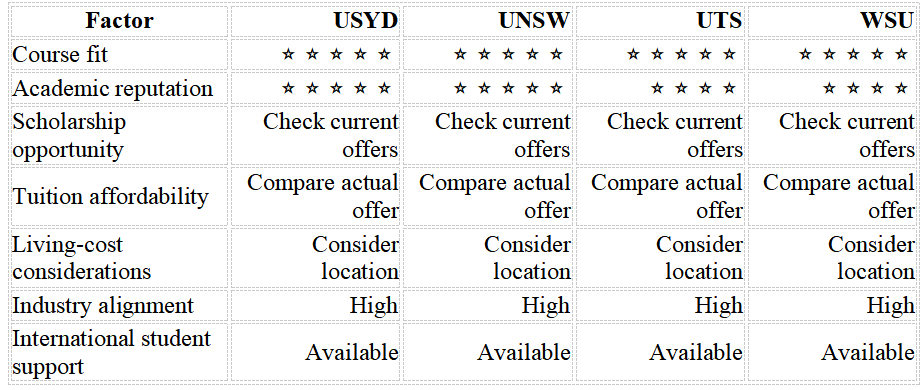
The exact score should be personalised to the student's course and circumstances.
Don't Choose the University First. Choose the Funding Strategy.
For families in Malaysia and Indonesia, this may be the most important lesson.
Instead of:
University → Course → Scholarship
consider:
Career → Course → Universities → Scholarships → Sponsorship → Net Cost → Final Decision
This approach gives you more options.
For example, a student might discover that:
· University A has the strongest ranking but no suitable funding.
· University B has a slightly lower ranking but a substantial scholarship.
· University C has a strong industry-focused course and a lower total cost.
· University D offers a pathway that reduces the initial financial commitment.
Suddenly, the decision becomes much clearer.
Final Checklist: Before You Say Yes to an Australian University
Before accepting an offer, make sure you can answer all of these questions:
☐ What exactly will I study?
☐ Why is this course right for my career?
☐ What are the total tuition fees?
☐ What scholarship can I receive?
☐ Is the scholarship renewable?
☐ What happens if I lose the scholarship?
☐ What will accommodation cost?
☐ What will my annual living expenses be?
☐ Are there government scholarships or sponsorships I can apply for?
☐ What are my Malaysia/Indonesia funding options?
☐ What is my backup university?
☐ What is my backup funding plan?
☐ What are the university and scholarship deadlines?
☐ What are the current Australian student visa requirements?
If you can answer all of these, you are making a much more informed decision.
The Bottom Line: Can You Afford to Study in Australia?
Studying in Australia can be a major financial investment.
But the sticker price is not necessarily the final price.
Scholarships, government programs, sponsorships, tuition discounts and alternative pathways can change the financial equation significantly.
For students from Malaysia and Indonesia, the smartest approach is therefore not simply to search for the “best university in Australia.”
Search for the best combination of:
University + Course + Scholarship + Sponsorship + Location + Career Outcome + Total Cost.
Whether your target is USYD, UNSW, UTS, Western Sydney University or another Australian university, start planning early.
And most importantly:
Don't ask only, “Can we afford Australia?” Ask, “What funding strategy can make Australia affordable?”
That is where the real opportunity begins.