
Australia’s International Education Reset: The End of an Era or a Necessary Evolution?
On 2 October, Australia introduced a new phase of changes to its international student visa framework.
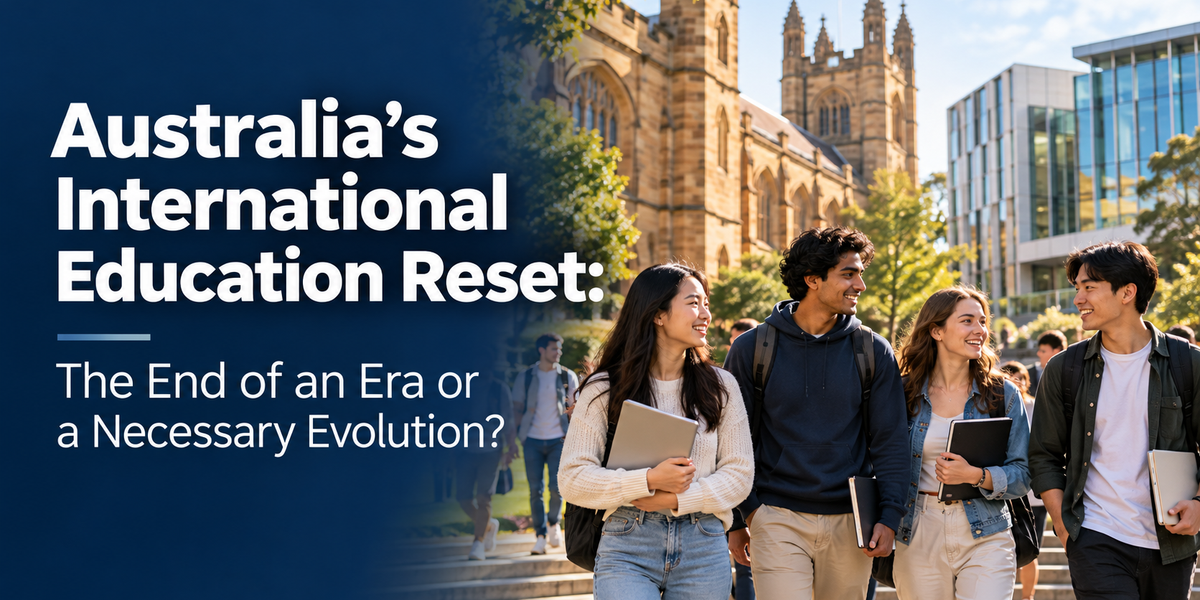
On 2 October, Australia introduced a new phase of changes to its international student visa framework. The message from the Australian Government is clear: Australia remains committed to international education, but the sector must become more sustainable, more transparent, and more focused on genuine students and genuine outcomes.
This is not about closing Australia’s doors. It is about redefining the future of international education — who we welcome, how students enter the system, and how education contributes to Australia’s long-term economic and workforce priorities.
A shift from growth at all costs to sustainable growth
The Government has been increasingly clear about its concerns: rapid growth, pressure on infrastructure and housing, misuse of visa pathways, and practices that do not always prioritise student outcomes.
The latest reforms demonstrate a stronger focus on:
· Strengthening the integrity of the Student visa system
· Reducing opportunities for visa hopping and pathway manipulation
· Ensuring students are choosing Australia primarily for education
· Protecting the reputation and quality of the Australian education brand
The direction is clear: the next chapter of international education will be built on quality, integrity, and sustainable growth — not simply increasing student numbers.
Does this mean the end of an era?
Perhaps. The era of rapid expansion driven largely by volume is likely changing.
However, international education markets are cyclical, and history shows that major destinations often go through periods of adjustment before finding a new balance.
The question is not whether international education will continue, but what the next model will look like.
Lessons from the UK and Canada
The UK provides an important example. The government introduced tighter migration settings, including restrictions around dependants of many international students, to address broader migration pressures.
While these changes created short-term challenges, the UK continues to recognise the significant economic, cultural, and academic value international students bring. The sector is adapting, not disappearing.
Canada has experienced a similar cycle. After introducing measures to manage rapid international student growth and strengthen system integrity, Canada continues to recognise the importance of attracting global talent and supporting genuine students.
The lesson from both markets is clear: leading education destinations do not abandon international education — they recalibrate it.
New Zealand: an emerging destination of interest
As Australia enters this period of transition, New Zealand is naturally becoming a destination of increased interest for students and industry stakeholders.
New Zealand offers many attractive advantages: quality education, safety, lifestyle, and a welcoming international reputation. For some students, it may appear as an alternative option while larger markets adjust.
However, an important question remains: how much capacity does New Zealand have, and how sustainable is that growth?
Every education market has limits. Accommodation, infrastructure, institutional capacity, labour market demand, and community acceptance all determine whether growth can be sustained.
New Zealand may benefit from increased interest in the short term, but history suggests that rapid growth eventually requires careful management. The challenge for any destination is not attracting students — it is maintaining quality while scaling responsibly.
What student behaviour is telling us (on Achieva AI)
Beyond policy announcements, student behaviour is providing valuable signals about where the market is heading.
Through insights from activity across the Achieva platform — including student searches, engagement patterns, and AI-powered conversations — we are seeing a clear evolution in how students make decisions.
Students are becoming more informed and are asking deeper questions:
· Which destination provides the strongest long-term opportunity?
· Which courses align with future career outcomes?
· What are the realistic pathways after graduation?
· Which education choices provide genuine value?
Students are no longer simply looking for a visa pathway. They are looking for certainty, transparency, and personalised guidance.
This reinforces the importance of combining technology with industry expertise. AI can help students explore options, understand pathways, and make better decisions, but the future will require a balance between digital innovation and trusted human advice.
Australia’s opportunity: quality over quantity
Australia remains one of the world’s most attractive education destinations. Its universities, vocational education providers, research capability, lifestyle, and global reputation remain strong.
The opportunity now is to build a stronger ecosystem focused on:
· Attracting genuine students with strong academic intentions
· Improving student experience and graduate outcomes
· Aligning education with workforce needs
· Strengthening ethical recruitment practices
· Using technology to create more transparent and personalised student journeys
It is also encouraging to see continued engagement with ASEAN and regional partners. Welcoming students from neighbouring countries remains strategically important, strengthening not only education links but also long-term economic and diplomatic relationships.
The next chapter requires collective responsibility
The future of Australian international education will depend on collaboration.
Government must protect system integrity. Providers must deliver quality outcomes. Agents must uphold ethical standards. Technology companies must help improve transparency and student decision-making.
The sector should not view these changes only as restrictions. They are also an opportunity to rebuild trust, improve quality, and create a more sustainable model.
This may be the end of one era — an era defined by rapid expansion. But it may also mark the beginning of another: an era where Australia competes not simply by being a large education market, but by being one of the most trusted, innovative, and high-quality destinations in the world.
The opportunity now is not to resist change, but to help shape what comes next.